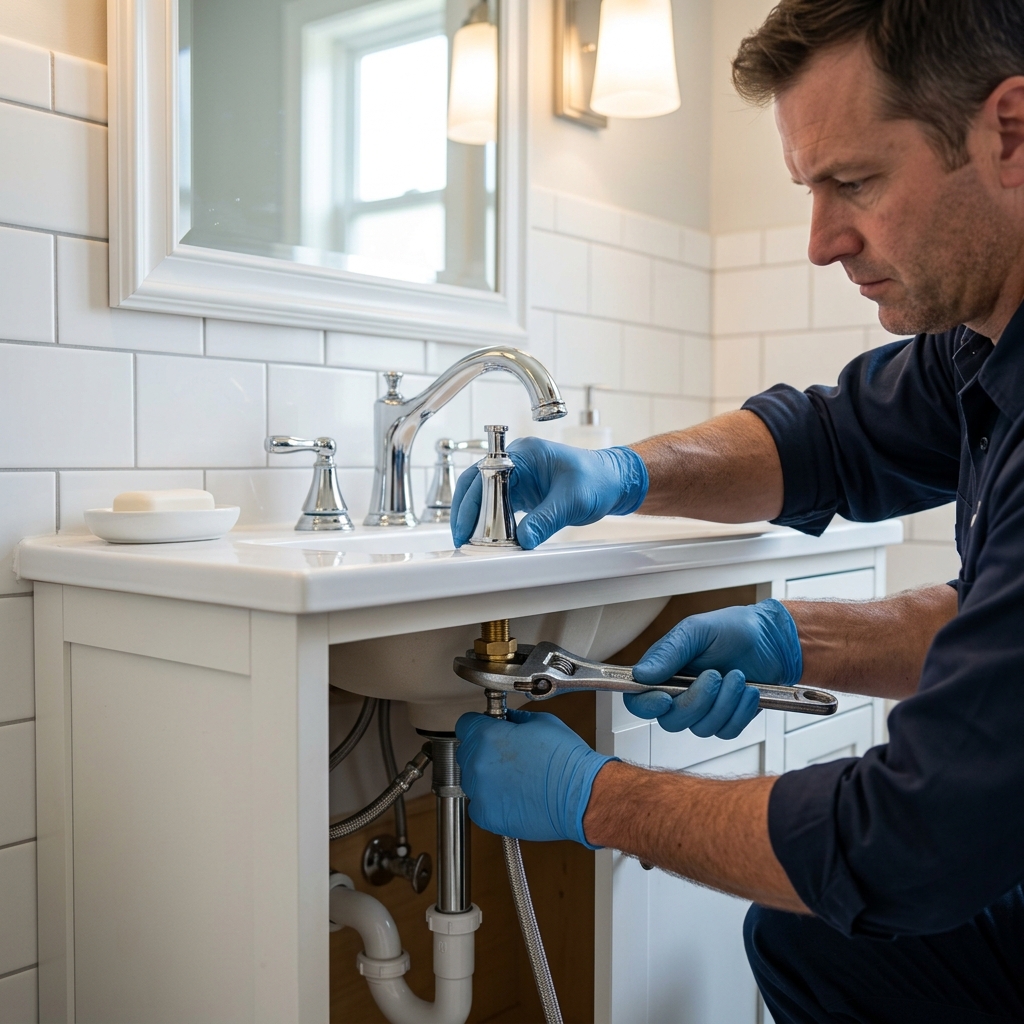
Bathroom faucet replacement in McAllen comes up more often than most homeowners expect. Hard water, daily use, and South Texas humidity wear down faucets from both inside and out. Cartridges get stiff. Aerators clog. Handles drip. And the finish corrodes faster in a steamy bathroom than anywhere else in the house.
We replace bathroom faucets across McAllen, Sharyland, Palmhurst, and the Rio Grande Valley. We pull the old faucet, install the new one, reconnect the drain assembly, and test for leaks. Same-day and next-day scheduling is available. Bathroom faucet replacement is one of our bathroom remodeling services in McAllen.
What Bathroom Faucet Replacement Includes in McAllen
A bathroom faucet replacement covers more steps than a kitchen swap. The pop-up drain linkage connects to the faucet body. When the faucet comes out, the stopper mechanism comes with it. Here’s what the full process looks like:
- Shut off the hot and cold supply valves under the vanity
- Disconnect the supply lines from the faucet shanks
- Disconnect the pop-up drain lift rod from the faucet body
- Remove the mounting nuts and pull the old faucet off the sink deck
- Clean the sink surface — mineral scale, old putty, silicone
- Set the new faucet and tighten the mounting hardware from below
- Thread the new lift rod through the faucet body and reconnect the pop-up linkage
- Adjust the stopper height so the drain opens and closes cleanly
- Connect the hot and cold supply lines
- Turn on the water and check every connection for drips
Most jobs in McAllen take about one hour. If the supply valves under the vanity are corroded or stuck, we replace them during the install. That prevents a second call later.
Signs Your Bathroom Faucet Needs Replacing
Not every drip means it’s time for a new faucet. But some signs point to damage inside the faucet body — not just a worn part.
- Leaking at the base of the spout. This usually means worn O-rings or a corroded valve seat. If the seat is damaged, a new cartridge won’t stop the drip.
- Stiff or stuck handle. Mineral scale from McAllen’s hard water builds up inside the cartridge over time. When the cartridge is fully scaled, the handle gets hard to turn.
- Dripping after a cartridge swap. You’ve already replaced the cartridge and it still drips. The damage is inside the faucet body itself.
- Low pressure from the aerator. Cleaning the aerator didn’t help. The buildup is inside the faucet, not the screen.
- Rust or finish breakdown. Bathroom humidity is hard on chrome and brushed nickel. Steam from daily showers speeds up exterior corrosion in South Texas homes.
- Cracked or corroded faucet body. Once the body is cracked, no repair holds.
Bathroom faucets corrode on the outside faster than kitchen faucets. Shower steam in an enclosed space is more intense than general kitchen humidity.
How to Choose the Right Faucet for Your Bathroom
Before you buy a replacement faucet, check your sink deck. Not every faucet fits every bathroom setup.
- Count the holes. Sinks come with one hole or three. A three-hole sink can be centerset (4-inch spread) or widespread (6–16 inches between handles and spout). The new faucet must match.
- Centerset vs. widespread. A centerset faucet uses one base plate covering both handles and the spout. A widespread faucet has handles and spout mounted separately in three distinct holes. Mixing these types means different sink or deck work.
- Single-handle vs. two-handle. Single-handle mixes hot and cold in one lever. Two-handle is the traditional bathroom look. Both work in a three-hole sink with the right mounting plate.
- Pedestal sinks. Pedestal sinks typically need a single-hole or wall-mount faucet. Check clearance between the faucet and the basin edge before buying.
- Dual-sink vanities. Master baths in north McAllen and Sharyland often have two-sink setups. Both faucets must match in style, finish, and hole configuration.
WaterSense-labeled bathroom faucets use at most 1.2 gallons per minute — at least 20 percent more efficient than the standard [1]. That adds up in a home where the bathroom faucet runs multiple times a day.
If you’re not sure what hole configuration your sink has, we check it before you buy anything.
What Makes Bathroom Faucet Replacement Tricky
Bathroom faucet replacement has a few complications you don’t run into on a kitchen job.
- Pop-up drain linkage. The lift rod that operates your sink stopper threads through the faucet body. A corroded or mismatched linkage must come out at the same time. If you skip it, the stopper won’t work right.
- Tight under-vanity workspace. Bathroom vanity cabinets are smaller than kitchen sink cabinets. Less room for hands, tools, and body position.
- Pedestal sink access. There’s no cabinet door to open — you can see everything. But there’s no shelf to brace against. The pedestal column also limits where a basin wrench can swing.
- Corroded mounting nuts. Hard water in older downtown McAllen homes fuses the mounting nut to the faucet shank. Breaking it loose without cracking the sink deck takes the right tools and patience.
- Dual-sink vanity. Each sink has its own faucet, supply lines, and pop-up linkage. That’s two full installs in one visit.
- Mismatched hole configuration. Replacing a centerset with a widespread faucet (or the other way) means the hole spacing doesn’t match. A different sink or deck modification is needed.
If any of these come up mid-job, we handle them. We see them on most bathroom faucet calls.
DIY vs. Professional Bathroom Faucet Replacement
Some bathroom faucet swaps go smoothly from start to finish. Others turn into bigger jobs.
DIY-friendly:
- The old faucet comes off without corroded nuts fighting back
- Supply lines are flexible braided hoses in good condition
- The pop-up drain linkage disconnects cleanly
- There’s enough room under the vanity to reach the mounting hardware
Call a professional:
- Supply valves are seized or haven’t been turned in years
- The pop-up drain linkage is corroded and stuck to the old faucet body
- You’re working on a pedestal sink with no cabinet for leverage
- Two faucets on a double vanity need to be replaced and matched
- The mounting nut won’t break free and force risks cracking the sink
The hardest part is almost always removal. Mineral scale from McAllen’s water locks down mounting nuts and supply connections. Forcing them can crack the supply line or chip the sink deck. If you hit resistance, call us rather than push through.
Frequently Asked Questions
How long does it take to replace a bathroom faucet?
Most straightforward swaps take about one hour. If we also replace the supply valves or do pop-up drain work, it takes a bit longer.
What is a pop-up drain assembly and why does it matter?
The pop-up assembly is the stopper in your bathroom sink drain. It connects to the faucet body through a lift rod. When the faucet comes out, the lift rod disconnects. If the linkage is corroded, we replace it at the same time as the faucet.
Does hard water damage bathroom faucets faster in McAllen?
Yes. McAllen’s water is very hard. Mineral deposits build up inside the cartridge and aerator over time. That causes stiff handles, slow drips, and low pressure at the spout. Bathroom humidity also wears the exterior finish faster than in dry rooms.
Can I replace a faucet on a pedestal sink myself?
Possibly. There’s no cabinet in the way, but there’s also no shelf to brace against. The pedestal column limits where a wrench can swing. If the mounting nuts are corroded, pedestal work gets difficult fast. Call us if the nuts won’t budge.
How does replacing a faucet work on a double-sink vanity?
Each sink is handled independently. We shut off each supply, remove the old faucet, install the new one, and reattach the pop-up linkage — twice. Make sure both replacement faucets match in style and finish before we arrive.
[1] U.S. Environmental Protection Agency — “Bathroom Faucets” – https://www.epa.gov/watersense/bathroom-faucets
Need This Service?
Call now for a free estimate. Same-day service available in McAllen.