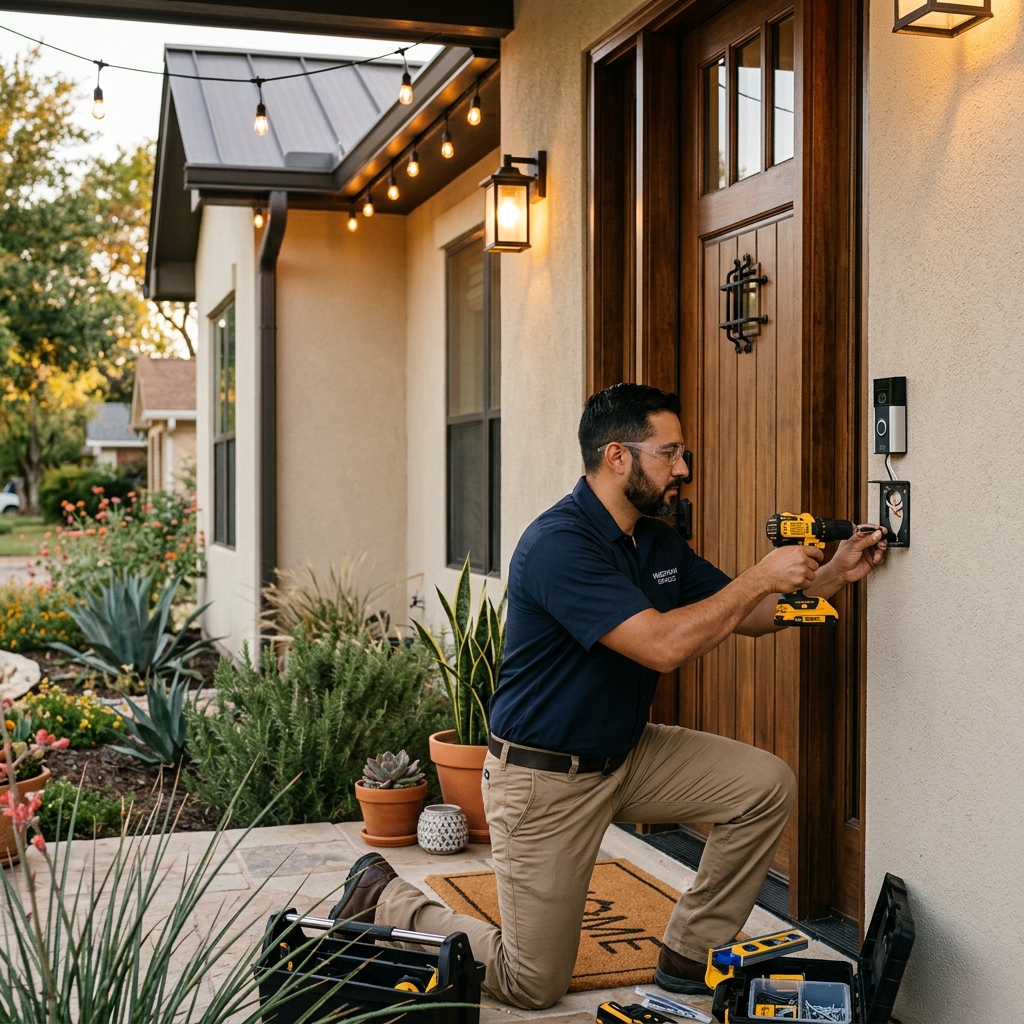
Ring doorbell installation in McAllen involves more than screwing a device to the wall. The right approach depends on whether your home has existing doorbell wiring, what your transformer can handle, and how strong your Wi-Fi signal is at the front door. We install both wired and battery Ring doorbells across McAllen, Sharyland, Palmhurst, and the Rio Grande Valley.
We handle the full job — mounting, wiring, app setup, and Wi-Fi troubleshooting. Most installs are done in a single visit. Ring doorbell installation is one of our property maintenance services in McAllen.
How Ring Doorbell Installation Works
Here’s what a standard Ring doorbell installation covers from start to finish:
- Select the right Ring model — wired or battery, based on your home’s wiring and your preference
- Test existing doorbell wiring for voltage and current capacity (wired installs only)
- Check or replace the transformer if it doesn’t meet Ring’s voltage requirements
- Drill and mount the Ring bracket to the wall, doorframe, or stucco surface
- Connect doorbell wires to the two terminals (wired model) or insert the charged battery pack (battery model)
- Attach the Ring faceplate
- Connect the device to your home Wi-Fi through the Ring app
- Test live view, motion alerts, and the doorbell chime
Most wired installs take one to two hours. Battery installs are faster — usually under an hour. If the transformer needs replacing, add another 30 to 45 minutes.
Wired vs. Battery Ring Doorbells — Which Is Right for Your Home?
The biggest decision before installing a Ring doorbell is whether to go wired or battery. Each has a clear use case.
Wired Ring doorbells use your home’s existing doorbell wiring. The device runs on low-voltage AC power continuously. There’s no battery to charge and no interruptions to video recording during recharge cycles. Wired models handle McAllen heat a bit better — the device temperature stays lower when it’s not relying on a battery that heats up in direct sun.
The catch: your home needs existing doorbell wiring that meets Ring’s voltage requirements. Many older homes in south McAllen and downtown McAllen have original two-wire doorbell systems. Most of those work — but the transformer may need upgrading (see the next section).
Battery Ring doorbells mount with screws and anchors only. No wiring required. This is the practical choice if your home has no existing doorbell at all. Battery life under normal conditions runs 6 to 12 months. In McAllen’s summer heat, expect that range to shrink — more on that below.
If your home already has doorbell wiring and your transformer is up to spec, a wired Ring model is usually the better long-term choice in South Texas. If you’re starting from scratch, the battery model gets the job done.
Existing Wiring and Transformer Requirements
Ring wired models require 16 to 24 volts AC at the doorbell terminals. The Ring Pro and Ring Pro 2 also require a transformer rated at 30VA or higher. That’s where older McAllen homes can run into a problem.
Most homes built before the 1990s in downtown McAllen and south McAllen came with builder-grade transformers rated at 10VA or 16VA. Those transformers power a simple doorbell chime without issue. They’re often not enough for a Ring Pro or Pro 2.
A low-VA transformer causes problems: the Ring device flickers, the internal backup battery fails to charge, or the app reports a power error. The fix is a transformer replacement. We test the transformer during the same visit and swap it if needed. The new transformer mounts at the same junction box as the old one.
Newer homes in north McAllen and Sharyland often have updated wiring and adequate transformers. We still test before mounting the device.
If your home has no doorbell wiring at all, the battery Ring model is your path forward. Running new doorbell wiring is a larger electrical project that goes beyond what a doorbell installation covers.
Wi-Fi Signal Through Stucco Walls
Ring requires a minimum of 2 Mbps upload speed at the doorbell’s physical location — not at the router. That distinction matters in McAllen, where stucco exteriors with metal lath are common.
Metal-reinforced stucco blocks Wi-Fi signal the same way concrete does. If your router sits at the back of the house and the front door is on the other side of one or two stucco walls, signal at the doorbell location can drop significantly. Weak Wi-Fi at the front door is one of the most common issues with Ring installs in McAllen [1].
There are three ways to address this:
- Ring Chime Pro — Ring’s own Wi-Fi range extender, designed to sit between your router and the front door. Plugs into a standard outlet.
- Mesh Wi-Fi node near the front of the house — a node placed in a front bedroom or near the entry puts a strong signal close to the doorbell location.
- Router repositioning — if the router can be moved to a more central location, that alone often solves the problem.
We test Wi-Fi signal at the mounting location before we drill. If signal is marginal, we tell you before finishing the install. A Ring that drops connection every few days is frustrating to live with.
Many current Ring models support both 2.4 GHz and 5 GHz Wi-Fi. For a doorbell mounted near an exterior wall, 2.4 GHz has better range and wall penetration. We set the device to 2.4 GHz by default when signal is the question.
South Texas Heat and Your Ring Doorbell
McAllen averages daily highs near 99°F from June through September. Add direct afternoon sun on a south- or west-facing door, and the surface temperature of a Ring doorbell can climb well above ambient air temperature.
Most Ring doorbells are rated to operate up to 120°F. That rating covers the device itself, but battery performance degrades long before the device reaches its limit. Lithium batteries lose capacity faster in sustained heat. A battery Ring doorbell on a west-facing door in Palmhurst or north McAllen — exposed to afternoon sun — can need a recharge every two to three months in summer rather than the advertised six to twelve.
Wired Ring doorbells handle the South Texas climate better in this regard. No battery to degrade, no recharge cycles. The device runs on AC power year-round.
If you stay with a battery model, a few things help. A shaded entry reduces heat buildup. Checking charge in June, before peak heat season, avoids a dead doorbell in July. If the battery drains faster than expected after the first full summer, it may have taken permanent heat damage — replacement packs are available separately.
Most Ring doorbells carry an IP55 weather resistance rating. McAllen’s morning humidity and occasional heavy rain are not a problem. Condensation on the camera lens clears on its own.
DIY vs. Professional Ring Doorbell Installation
Battery Ring doorbell installation is one of the more DIY-friendly smart home tasks. The device mounts with screws. The app walks through setup step by step. Most homeowners with a basic drill can handle it.
Wired Ring installation is more involved.
Good candidates for DIY:
- Battery model on a wood or vinyl doorframe
- Existing doorbell wiring confirmed to be working and correctly rated
- Wi-Fi signal confirmed strong at the front door already
Call a professional when:
- Transformer needs testing or replacing (involves 120V line voltage at the transformer)
- Mounting surface is stucco or brick — masonry drilling required
- Wired model, but doorbell wiring is old, spliced, or unknown condition
- Wi-Fi signal is weak and you need help diagnosing the source
- No existing doorbell and you want a wired option
We bring the tools for stucco and masonry. We test transformer voltage, complete any needed swap, mount the device, and walk through app setup before we leave. The job gets done in one visit.
Frequently Asked Questions
Does a Ring doorbell need existing doorbell wiring?
No. Battery Ring models need no wiring at all — they mount with screws and run on a rechargeable battery. Wired Ring models use existing two-wire doorbell wiring. If your home has no existing doorbell, the battery model is the right choice.
What voltage does a Ring doorbell require?
Most wired Ring models need 16 to 24 volts AC. The Ring Pro and Ring Pro 2 need a transformer rated at 30VA or higher. Standard transformers in older McAllen homes are often rated at 10VA or 16VA. We test transformer output before mounting and replace it during the same visit if needed.
My Wi-Fi is weak at my front door — will Ring still work?
Ring needs at least 2 Mbps upload speed at the doorbell location. Stucco walls with metal lath, common in McAllen, reduce Wi-Fi range. If signal is marginal, a Ring Chime Pro or a mesh Wi-Fi node near the front of the house typically solves the problem. We test signal before finishing the install.
How long does a Ring doorbell battery last in McAllen’s heat?
Under normal conditions, Ring battery life runs 6 to 12 months. In McAllen’s summer heat — especially on south- or west-facing doors with direct sun — expect to recharge every 2 to 4 months during peak summer. Wired Ring models avoid this issue entirely.
Can a handyman install a Ring doorbell?
Yes. Ring doorbell installation falls within handyman scope for both battery and wired models. If the job requires a transformer replacement, we handle that in the same visit. Work beyond doorbell wiring — new circuits or panel work — requires a licensed electrician.
[1] U.S. Federal Communications Commission — “Home Networking” — https://www.fcc.gov/consumers/guides/home-networking
Need This Service?
Call now for a free estimate. Same-day service available in McAllen.