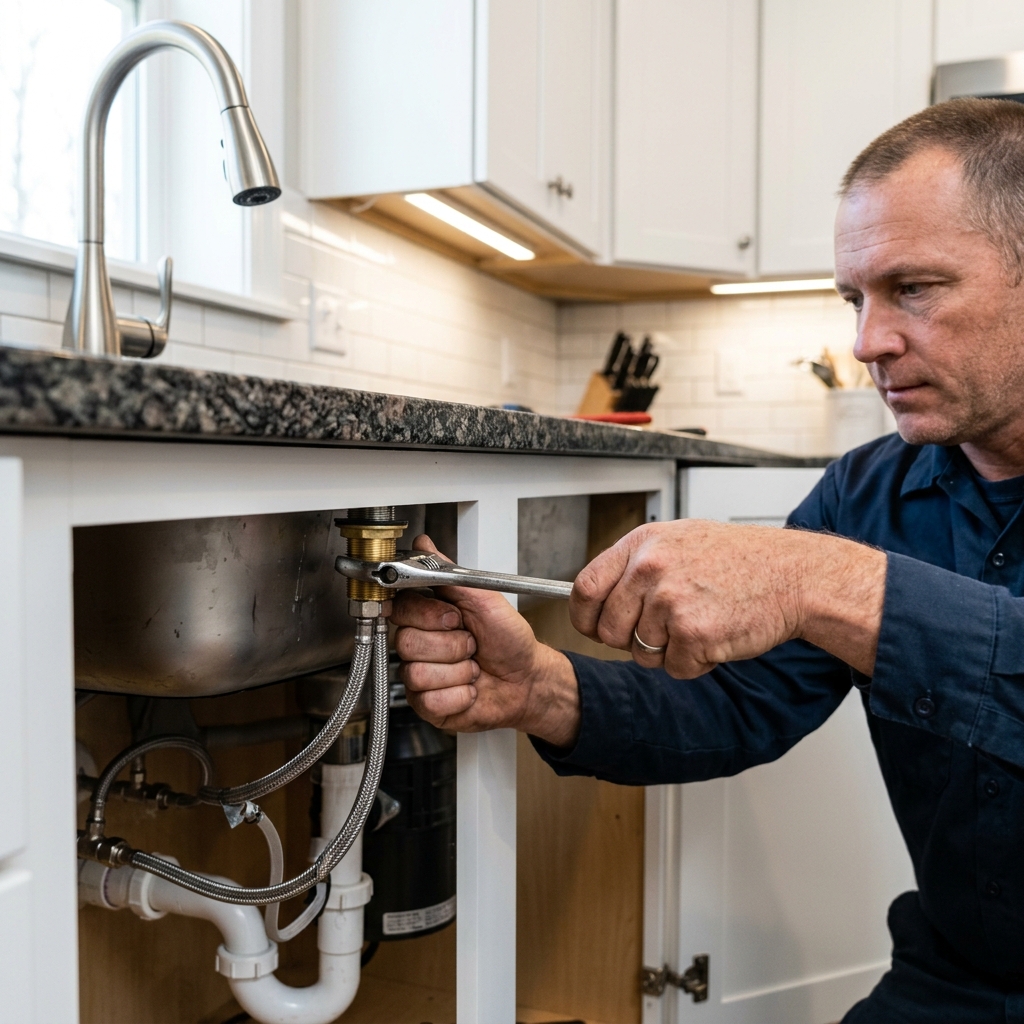
In McAllen, kitchen faucets take a beating. Between hard water, daily use, and South Texas heat, they wear out faster than you’d expect. When yours starts dripping, leaking, or locking up, it’s time for a replacement.
We replace kitchen faucets across McAllen, Sharyland, Palmhurst, and the Rio Grande Valley. We remove the old faucet, install the new one, and test every connection. Same-day and next-day scheduling is available. Kitchen faucet replacement is one of our kitchen remodeling services in McAllen.
What Kitchen Faucet Replacement Includes in McAllen
A kitchen faucet replacement covers everything from shutting off the water to testing the new faucet. Here’s what the process looks like:
- Shut off the hot and cold supply valves under the sink
- Disconnect the old supply lines from the faucet
- Remove the mounting nuts and lift the old faucet off the sink
- Clean the sink surface — mineral buildup, old putty, silicone
- Set the new faucet and tighten the mounting hardware
- Connect the hot and cold supply lines
- Turn on the water and check every connection for leaks
Most replacements in McAllen are straightforward swaps. These take about an hour. If the supply valves are corroded or stiff from hard water, we replace them during the install. That prevents future problems.
Signs Your Kitchen Faucet Needs Replacing
Not every drip means you need a new faucet. But some signs point to a faucet that’s past repair.
- Leaking at the base. This usually means worn O-rings or a corroded valve seat. If the seat is damaged, a new cartridge won’t fix it.
- Persistent drip. You’ve replaced the cartridge or washer and it still drips. The damage is inside the faucet body.
- Stiff handle. Hard water deposits build up inside the cartridge. In McAllen, this happens faster than in most cities.
- Low water pressure. If cleaning the aerator doesn’t help, the buildup is inside the faucet itself.
- Rust or discoloration. Hard water breaks down the finish over time. Once the body starts corroding, the faucet is done.
- Cracked sprayer hose. Common on pull-down faucets after years of daily use. The hose dries out and cracks.
How to Choose the Right Faucet for Your Kitchen Sink
Before you buy a faucet, check your sink. Not every faucet fits every setup.
- Count the holes. Kitchen sinks come with 1-hole, 3-hole, or 4-hole configurations. Your new faucet needs to match — or use a deck plate to cover the extras.
- Single-handle vs. two-handle. Single-handle is the most common choice for kitchens now. It’s easier to use and takes up less space.
- Pull-down vs. side sprayer. A pull-down sprayer is the standard upgrade. It’s built into the faucet head and keeps the sink area cleaner.
- Check your clearance. Measure from the faucet center to the backsplash. Tall faucets need room to swing without hitting the wall.
- Match the connections. Most kitchen faucets connect to standard 3/8-inch supply lines. Check your supply lines before buying.
Newer kitchens in Sharyland and north McAllen often have granite or quartz countertops. The faucet mounts through the stone. Make sure the hole count matches — drilling new holes in stone is a separate job. A WaterSense-labeled faucet uses less water without losing pressure [1].
DIY vs. Professional Kitchen Faucet Replacement
Some faucet swaps are simple. Others turn into bigger jobs fast.
DIY-friendly:
- The old faucet comes off easily
- Flexible supply lines are in good shape
- You have room to work under the sink
- Standard mounting with accessible nuts
Call a professional:
- Supply valves are corroded or seized
- Old rigid copper supply tubes instead of flexible hoses
- Granite countertop — overtightening can crack the stone
- Garbage disposal or water filter blocks access under the sink
The hardest part of a faucet replacement is almost always removing the old one. Mineral deposits lock down the mounting nuts. Forcing them can crack the supply line or damage the sink.
What Makes Kitchen Faucet Replacement Tricky
Kitchen faucet replacement looks simple on paper. In practice, a few things can slow it down.
- Corroded mounting nuts. Hard water scale fuses the nut to the faucet shank. A basin wrench helps, but sometimes the nut has to be cut off.
- Seized supply valves. Old gate valves that haven’t been turned in years may not close all the way. We replace them so the shutoff works.
- Tight workspace. Under-sink cabinets with a garbage disposal, water filter, or stored items leave almost no room to reach the connections.
- Mismatched holes. The old sink has three holes but the new faucet needs one. A deck plate covers the extras.
- Damaged sink surface. Removing an old faucet sometimes reveals cracks or worn mounting holes underneath.
- Old sealant. Putty or silicone left behind must be fully cleaned before the new faucet can seal properly.
If any of these come up during a DIY attempt, call us. We deal with them on most jobs.
Frequently Asked Questions
How long does it take to replace a kitchen faucet?
A straightforward swap takes about one hour. If we need to replace supply valves or handle corroded connections, it takes a bit longer.
What tools do I need to replace a kitchen faucet?
A basin wrench, adjustable wrench, plumber’s putty or silicone, and Teflon tape. A headlamp helps — it’s dark under the sink.
Can I install a one-hole faucet on a three-hole sink?
Yes. A deck plate covers the extra holes. Most faucets come with one. If yours doesn’t, we can supply it.
What are the different types of kitchen faucets?
Single-handle, two-handle, pull-down, pull-out, and touchless. Single-handle with a pull-down sprayer is the most common choice for kitchen replacements.
How do I fix low water pressure after installing a new faucet?
Check the aerator for debris — new faucets often catch sediment on the first use. Also make sure both supply valves are fully open and the lines aren’t kinked.
[1] U.S. Environmental Protection Agency — “WaterSense Statistics and Facts” – https://www.epa.gov/watersense/statistics-and-facts
Need This Service?
Call now for a free estimate. Same-day service available in McAllen.