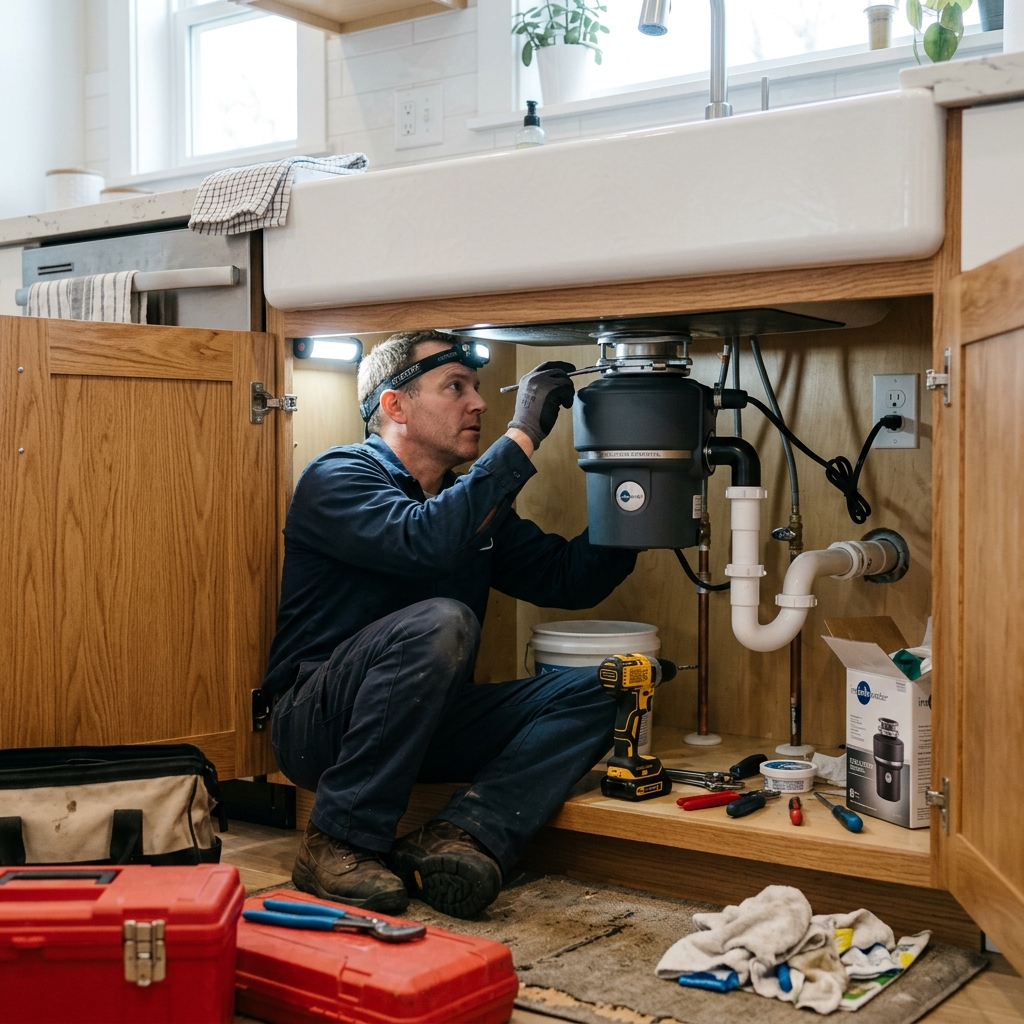
Garbage disposal replacement in McAllen is one of the more common kitchen calls we get. When a disposal starts humming without grinding, leaks from the base, or trips the reset button daily, the unit is done. Most disposals last 10 to 15 years. Many homes in south McAllen and downtown McAllen are running units well past that mark.
We replace garbage disposals across McAllen, Sharyland, Palmhurst, and the Rio Grande Valley. One visit — we disconnect the old unit, mount the new one, and reconnect the plumbing and wiring. If you have a dishwasher, we handle that drain connection too. Disposal work is part of our appliance services in McAllen.
How Garbage Disposal Replacement Works
Here is what the replacement process looks like from start to finish:
- Shut off power at the breaker
- Disconnect the drain line and dishwasher drain hose (if connected)
- Loosen the mounting ring and drop the old unit
- Remove the old mounting bracket and clean the sink flange area
- Install the new mounting bracket and sink flange
- Mount the new disposal and lock it into the bracket
- Reconnect the drain line and dishwasher drain hose (remove knockout plug if new unit)
- Restore power and run a test
Most McAllen replacements take under an hour.
Signs Your Garbage Disposal Needs to Be Replaced
Not every disposal problem means a full replacement. But these five signs usually do.
Humming but not spinning. The motor is running but the flywheel is stuck. Try the hex key socket on the bottom of the unit to free it manually. If the jam clears but keeps coming back, or the motor trips the reset often, the unit needs to go.
Frequent resets. The reset button is a thermal overload — it trips when the motor runs too hot. Hitting it once in a while is normal. Needing it every week means the motor is failing.
Leaking from the base. This one is not repairable. The internal seals have failed. Water leaking from the bottom of the unit means it needs to come out.
Persistent bad smell. Grinding chambers trap food in cracks as the unit ages. Cleaning helps for a while. If the smell returns fast, the chamber itself is too worn to clean out.
Slow draining. If water backs up in the sink, the grinding ring may be too worn to process food fully. A partial jam with the disposal still running is another common cause.
Hard water in South Texas speeds all of this up. Mineral scale collects on internal seals and parts. McAllen water runs at roughly 243 PPM hardness. That buildup wears on seals and cuts grinding efficiency over time.
What Garbage Disposal Replacement Includes
Our replacement service covers the full job — not just the swap.
We remove the old unit, including the mounting ring, wiring, and drain connection. We check the sink flange for corrosion or cracking. A flange in bad shape gets replaced before we mount the new unit. Then we install the new disposal, lock it to the bracket, and reconnect the drain line and electrical.
If your dishwasher drains through the disposal, we handle that connection too. New disposal units come with a knockout plug over the dishwasher drain port. If that plug stays in, your dishwasher has nowhere to drain. We confirm the setup and check for leaks before we leave.
Most homes in Sharyland and north McAllen are straightforward swaps — same mounting system, easy access. Some older homes in south McAllen and downtown have corroded flanges or tight undersink clearances. We check that before the job starts.
Choosing the Right Garbage Disposal Size
Disposal motors are rated in horsepower. The right size depends on your household and how often you cook from scratch.
| HP | Best for |
|—-|———-|
| 1/3 HP | 1–2 person household, light use |
| 1/2 HP | Most homes — 2–4 people, standard cooking |
| 3/4 HP | Families of 4+ or heavier cooking loads |
| 1 HP | Large household or near-commercial use |
Most McAllen homes do well with a 1/2 HP unit. Larger families, or those who cook often, should step up to 3/4 HP. A bigger motor handles food scraps more thoroughly. It also runs cooler under load, which means less motor strain and a longer life.
Brand matters less than motor size. Pick the horsepower that fits your kitchen, then choose a brand within your budget. We can advise on sizing before you buy.
DIY vs. Professional Garbage Disposal Replacement
Some disposal swaps are DIY-friendly. Others are not.
DIY-friendly:
- Replacing with the same brand and model (mounting ring stays in place)
- No dishwasher connected to the disposal drain
- Comfortable with basic electrical disconnects and drain work
Call a professional:
- Different brand or mounting system (requires new bracket and sink flange work)
- Dishwasher drain is connected (knockout plug must be removed — leaving it in floods the dishwasher)
- Corroded flange or drain fitting — forcing old fittings can crack the drain line
- Wiring is hardwired, not a standard plug-in
The job looks simple from the outside. But a wrong knockout plug decision floods the dishwasher the first time it runs. A loose drain connection leaks under the sink for days before anyone notices. If you’re not sure, the time saved on labor isn’t worth a water-damaged cabinet.
What Not to Put Down Your Garbage Disposal
A disposal doesn’t grind everything equally. Some foods damage the unit. Others clog the drain line further downstream.
Avoid putting these down the disposal:
- Grease, fats, or cooking oil — solidifies in the drain line and builds up over time
- Fibrous vegetables (celery, artichoke leaves) — wraps around the flywheel and jams the motor
- Starchy foods (potato peels, pasta, rice) — expands with water and creates paste in the drain
- Bones and fruit pits — too hard for residential motor HP to process
- Coffee grounds — fine grounds build up in the drain trap over time
- Eggshells — the gritty membrane layer can coat the grinding ring
The EPA notes that sending food and grease down the drain creates issues further into the wastewater system [1]. Running cold water during grinding and for a few seconds after helps flush scraps fully through the line.
In McAllen, grease that goes down the drain meets mineral scale already coating the inside of pipes. That combination narrows the drain line faster than it would in a soft-water city. Keeping grease out of the disposal protects both the unit and your plumbing.
Frequently Asked Questions
Why is my garbage disposal humming but not spinning?
The motor is running but the flywheel is stuck. Use the hex key socket on the bottom of the unit to free the plate manually. If the jam clears but keeps returning, the motor is overloaded or failing. At that point, replacement is the right call.
How long do garbage disposals last?
Most disposals last 10 to 15 years. In McAllen, hard water buildup on seals and grinding parts can shorten that window. Units that run often without proper use habits wear out faster.
Does replacing a garbage disposal require a plumber?
Not typically. Disposal replacement involves a simple drain line disconnect and a wiring connection. We handle both as part of the job. You do not need to book a separate plumber or electrician.
How does hard water affect a garbage disposal?
McAllen water runs at roughly 243 PPM hardness. Mineral deposits collect on internal seals and the grinding ring over time. Grinding efficiency drops, seals fail sooner, and the unit may need replacing before the 10–15 year mark.
Does a garbage disposal need to be connected to the dishwasher drain?
Yes, if your dishwasher is present. The dishwasher drain hose connects to a port on the side of the disposal. New units ship with a knockout plug covering that port. If the plug is not removed during install, the dishwasher cannot drain. We confirm the connection and test both before we leave.
[1] U.S. Environmental Protection Agency — “Preventing Wasted Food At Home” – https://www.epa.gov/recycle/preventing-wasted-food-home
Need This Service?
Call now for a free estimate. Same-day service available in McAllen.